
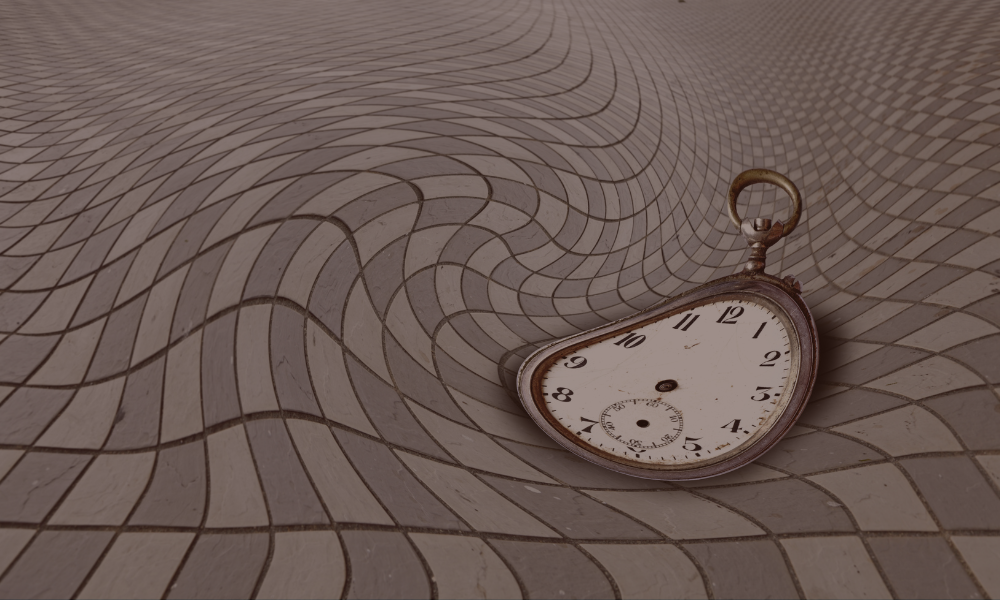
We speak of time as though it were a tangible possession: something to manage, save, spend, lose, or waste. We measure our lives in birthdays, deadlines, milestones, and carefully constructed timelines, assigning meaning to our existence according to how much we have accomplished by a certain age. Somewhere along the way, we began treating life as a race against an invisible clock.
I am no longer convinced that this is the only way to understand our existence. I do not believe time, as we have been taught to experience it, is real—and I am better off for questioning it.
Of course, I understand that clocks exist. The earth rotates, seasons change, and our bodies age. Time has practical applications, and I am not suggesting otherwise. What I question is the authority we have given it over our lives: the belief that there is one universal schedule against which our progress must be measured.
The distinction matters because the measurement of life is not the same as the experience of living it.
Rethinking Time Through African Philosophy
My curiosity about time has led me toward African philosophy, particularly the work of Kenyan theologian and philosopher John S. Mbiti. In African Religions and Philosophy (1969), Mbiti explores conceptions of time in traditional African religious thought that differ from the linear, clock-oriented framework that dominates many modern societies. His work offers an alternative perspective on the relationship between the present, the past, the future, and the events that give life meaning.
Mbiti describes two dimensions of time: Sasa and Zamani.
Sasa encompasses the immediate present, the recent past, and the near future—the sphere in which people actively experience life, maintain relationships, and participate in their communities. Zamani represents a deeper temporal dimension into which events recede, becoming part of collective memory, history, and ancestral existence.
Rather than treating time exclusively as an endless succession of abstract dates, this framework emphasizes lived experience, communal participation, and the significance of events.
What interests me most about this perspective is its invitation to reconsider what makes a moment meaningful.
A conversation with an elder, a family gathering, a spiritual ceremony, or an afternoon spent tending to the land can possess a significance that no clock can adequately communicate. The event itself gives the moment substance. Time is not merely passing; something is happening.
This is not to suggest that every African society understands time identically, nor that Mbiti’s interpretation represents a universal African worldview. African philosophies are diverse, and his account has been debated by scholars who question the extent to which distinct societies can be understood through a single framework.
Nevertheless, his work challenges the assumption that the modern Western conception of time is universal. It reminds us that our relationship with time is shaped, in part, by culture, history, and the systems through which we organize our lives.
And that is where the conversation becomes personal.
The Difference Between Clock Time and Lived Experience
Consider how differently we experience time depending on what we are doing.
An hour spent in conversation with someone we love may disappear almost imperceptibly, while an hour spent in an anxious waiting room can feel interminable. A season of grief may leave us feeling suspended, while a season of growth can make months feel as though they have passed in a single breath.
The clock records the same sixty minutes, but our experience of those minutes is profoundly different.
If time were the only meaningful measure of our lives, these differences would be difficult to explain. Perhaps, then, what we call time is not simply something that happens to us. Perhaps it is also something we experience, interpret, and give meaning to through our attention, relationships, and participation in the world.
I find this distinction important because it creates room for a different understanding of a life well lived.
We are often encouraged to think about our lives in terms of efficiency. How much can we accomplish in a day? How quickly can we reach a goal? How many years will it take to become the person we envision ourselves becoming?
These questions are not inherently misguided. Planning matters. Ambition matters. There is value in being intentional about how we spend our days.
But I wonder what happens when the desire to use our time well becomes an inability to simply experience it.
When every moment must be productive, every year must yield a recognizable achievement, and every season must move us closer to some predetermined destination, we risk turning our lives into projects that are never quite finished.
We become so concerned with what comes next that we forget to consider what is happening now.
The Tyranny of the Timeline
This realization has implications for how we understand ambition and adulthood.
We have inherited timelines that tell us when we should graduate, establish careers, find love, accumulate wealth, and achieve some recognizable version of success. We are taught to associate certain ages with particular accomplishments, as though adulthood were a sequence of milestones that everyone should reach in roughly the same order.
When our lives diverge from these expectations, we often interpret the difference as failure. We describe ourselves as behind, late, or running out of time.
Behind whom, exactly?
Late for what?
These questions have become increasingly important to me.
I am learning that a life cannot be evaluated fairly through comparison alone. Two people may reach the same milestone at different ages, having traveled through entirely different circumstances. One may have spent years surviving, healing, caring for others, or discovering who they are. Another may have enjoyed the resources and stability necessary to move more quickly.
To compare their timelines without considering their realities is to mistake uniformity for fairness.
We rarely account for the invisible labor that makes up a life. We do not always see the years spent recovering from disappointment, navigating family responsibilities, rebuilding confidence, or learning how to exist outside the expectations imposed upon us. We see the outcome, but not necessarily the conditions that made it possible.
And yet we use age as though it tells us everything we need to know.
There is something deeply limiting about a worldview that treats a person as behind simply because their life has not unfolded according to a socially approved schedule.
What if a slower season is not evidence of stagnation? What if beginning again is not the same as starting from nothing? What if the years we struggle to explain to others are the very years in which we are learning the most about ourselves?
I do not believe every delay is meaningful, nor do I think every difficult experience needs to be reframed as a lesson. Some things are simply difficult. Some losses are unfair. Some circumstances genuinely limit our opportunities.
But I do believe that we should be careful about interpreting a life through milestones alone.
A timeline can tell us when something happened. It cannot, by itself, tell us what that experience required of us, what it changed within us, or what it made possible.
Becoming Does Not Follow a Schedule
Rejecting the tyranny of the clock does not mean abandoning responsibility or refusing to plan for the future. It means refusing to confuse urgency with importance.
There is a difference between being intentional about where I am going and believing that I must arrive there by an arbitrary deadline. I can pursue ambition without allowing it to become a punishment for the person I am today.
This is where I find the greatest freedom in questioning time.
I can acknowledge the past without living permanently inside it. I can prepare for the future without sacrificing the present to an imagined version of myself. I can allow becoming to be a process rather than a performance.
Perhaps this is what it means to live cyclically: to recognize that growth has seasons, that some periods are devoted to planting while others require patience, and that a harvest cannot be forced simply because we are eager to reap.
Nature does not apologize for its seasons. A field does not consider itself unsuccessful because it is not bearing fruit in winter. Yet we frequently deny ourselves the same grace, expecting continuous productivity from lives that are inherently seasonal.
We want to be growing all the time. We want visible evidence that our efforts are working. We want to know that the difficult season is leading somewhere, preferably somewhere we can identify, explain, and measure.
But not every season produces something immediately recognizable.
Some seasons are for gathering information. Others are for letting go. Some ask us to build, while others ask us to reconsider what we have built and whether we still want it.
There are periods in which we become more visible to the world, and others in which our most important work happens privately.
I am learning to appreciate the season I inhabit without demanding that it resemble another.
There are things I understand now that I could not have understood five years ago. There are versions of myself I had to outgrow before I could recognize what I truly wanted. There are ambitions I have reconsidered, expectations I have released, and questions I have learned to sit with rather than rush to answer.
None of this feels like wasted time simply because it did not produce an immediately visible achievement.
Perhaps personal growth is not always about becoming more, doing more, or arriving somewhere new. Sometimes it is about developing the discernment to recognize what no longer belongs to us. Sometimes it is about learning to want different things. Sometimes it is about understanding that the life we once pursued is not necessarily the life we still desire.
These changes may be difficult to quantify, but their significance is not diminished by their invisibility.
Reclaiming My Relationship With Time
I do not need to believe that time is literally unreal to recognize that its authority over my identity is negotiable.
Clocks may organize my appointments, but they do not determine my worth. Calendars may structure my plans, but they cannot tell me whether I am becoming the person I want to be. Age may describe the length of my life, but it cannot adequately measure its depth.
Perhaps the goal is not to escape time but to reclaim our relationship with it.
To become more attentive to the moments that shape us, the relationships that sustain us, the histories that inform us, and the possibilities that remain open to us.
I want a life measured not only by what I accomplish, but by what I understand. Not only by how quickly I arrive, but by who I become along the way.
I want to make room for the unhurried conversation, the unexpected discovery, the necessary ending, and the quiet beginning that nobody else can see.
I want to be able to pursue a goal without resenting the time it takes to achieve it. I want to ` recognize that a meaningful life can include periods of uncertainty, redirection, and rest without treating them as interruptions to some more important version of living.
Most of all, I want to resist the temptation to turn my own life into a competition against an imagined deadline.
There will always be something I have not yet done, something I have not yet learned, and some version of myself I have not yet become. If I measure my life exclusively against those unfinished possibilities, I will always find myself lacking.
There will always be another milestone to reach, another expectation to satisfy, another reason to believe that I should be further along than I am.
But I am beginning to question whether a life spent perpetually trying to catch up is a life I want to live.
If time is a clock, I will continue to use it. But I will no longer allow it to convince me that I am running out of life simply because I am not moving according to someone else’s schedule.
There is still so much to learn, to experience, to heal, and to become. And I would rather meet that possibility with curiosity than fear.
Perhaps I am not behind.
Perhaps I am simply living.
And for now, that is more than enough.
References
Mbiti, J. S. (1969). African religions and philosophy. Heinemann.